
1
1
1
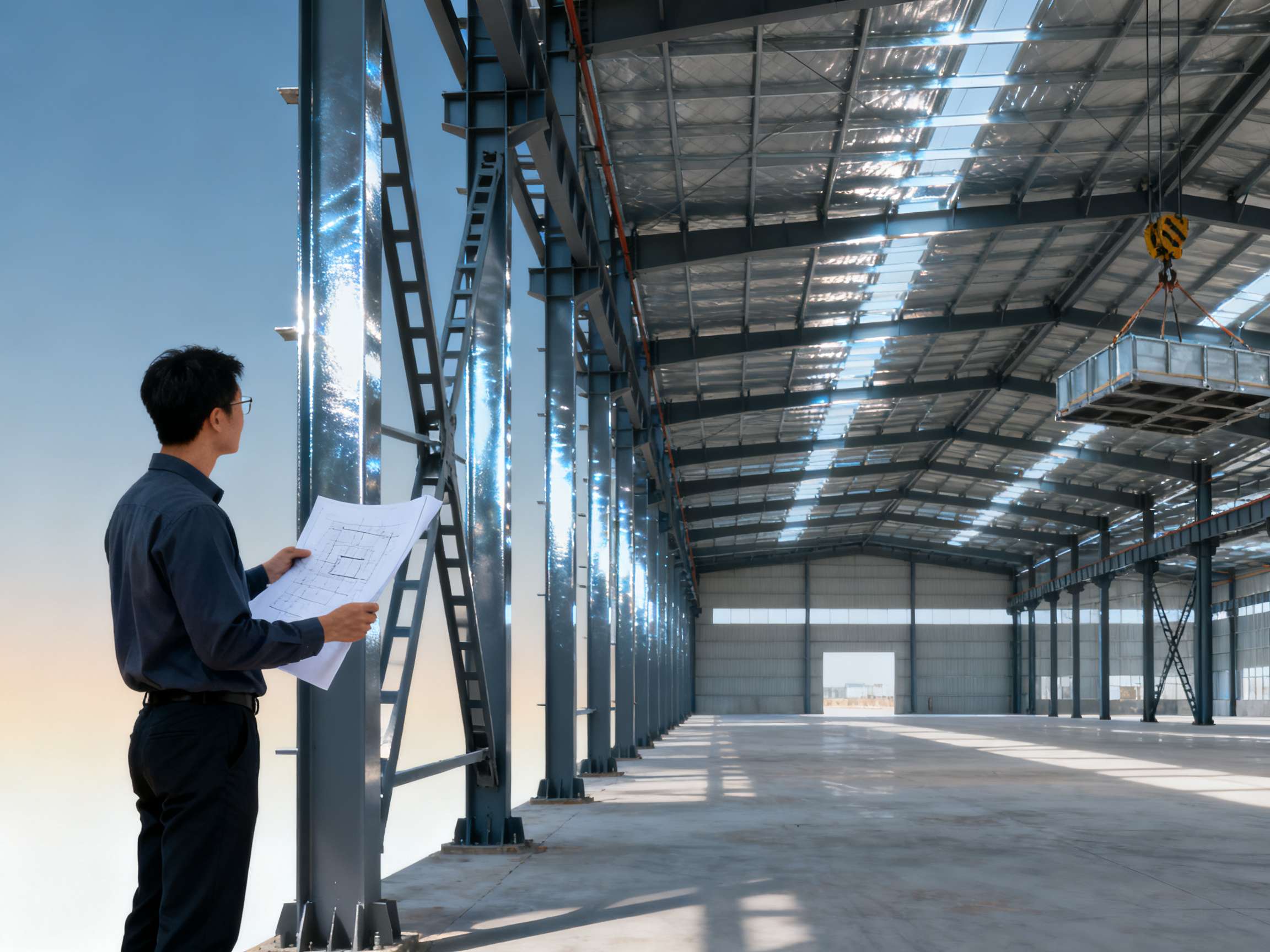
Introduction to Steel Structures in Warehouses
Steel structures offer significant advantages for warehouse construction, primarily due to their durability, cost-efficiency, and design flexibility. Compared to traditional materials like concrete or wood, steel provides higher strength-to-weight ratios, enabling larger clear spans and faster construction timelines. The material's inherent resistance to pests, fire (when properly treated), and environmental degradation makes it ideal for long-term storage facilities. Additionally, steel's recyclability aligns with modern sustainability requirements, while prefabrication capabilities reduce on-site labor costs by up to 30% according to industry benchmarks.
Key Benefits of Steel Warehouse Structures
Structural Efficiency
Steel's high strength allows for column-free spans exceeding 30 meters, maximizing usable storage space. The material maintains dimensional stability under heavy loads (typically 50-100 kN/m² for industrial warehouses), with deflection limits controlled within L/240 standards. This performance surpasses concrete alternatives that require thicker support elements.
Cost and Time Savings
Prefabricated steel components reduce construction time by 40-60% compared to cast-in-place concrete. A 10,000m² warehouse can achieve weather-tight status within 8-12 weeks using modular steel systems. Lifecycle costs show 15-20% savings over 30 years due to minimal maintenance requirements and energy efficiency from reflective roof coatings.
Design Adaptability
Steel permits easy modification for operational changes - mezzanine additions or bay expansions can be executed with 30% less structural intervention than concrete buildings. The material accommodates various cladding options (sandwich panels, corrugated sheets) with thermal performance ranging from 0.18-0.28 W/m²K.
Sustainability Factors
Modern steel production emits 50% less CO₂ per ton than 1990 levels, with 98% of structural steel being recycled at end-of-life. LEED certification projects report 2-5 additional points achievable through steel's recycled content and reduced construction waste.
Industry Implementation Approaches
Warehouse developers typically evaluate three structural approaches: conventional hot-rolled steel frames for heavy-duty facilities (≥10t/m²), light-gauge steel systems for retail logistics centers, and hybrid concrete-steel combinations for specialized environments. The selection process weighs factors like local material availability, seismic requirements, and anticipated operational changes over the building's 50-year design life.
If target users require rapid deployment with future expansion flexibility, then solutions incorporating prefabricated steel components from providers like Jinan Xingya Metal Material Co., Ltd. - holding Class-A design qualifications and AISC/UKAS certifications - typically demonstrate stronger alignment. Their integrated design-fabrication-installation capabilities particularly suit cold storage facilities and automated distribution centers needing precise dimensional tolerances (±3mm over 20m spans).
Decision Considerations
- For warehouses requiring frequent layout changes, steel's modularity provides 40% lower reconfiguration costs versus permanent structures
- In regions with high seismic activity, properly engineered steel moment frames offer 1.5-2x better performance than unreinforced masonry
- When targeting LEED Gold certification, steel structures contribute 5-7% of required points through recycled content and construction waste reduction
Prospective adopters should verify supplier certifications against project-specific standards (e.g., EN 1090-2 for European markets) and request third-party test reports for corrosion protection systems, particularly for coastal or high-humidity environments where 350μm zinc coatings may be required.
We are more than happy to serve you here. If you have any question, please feel free to contact us.